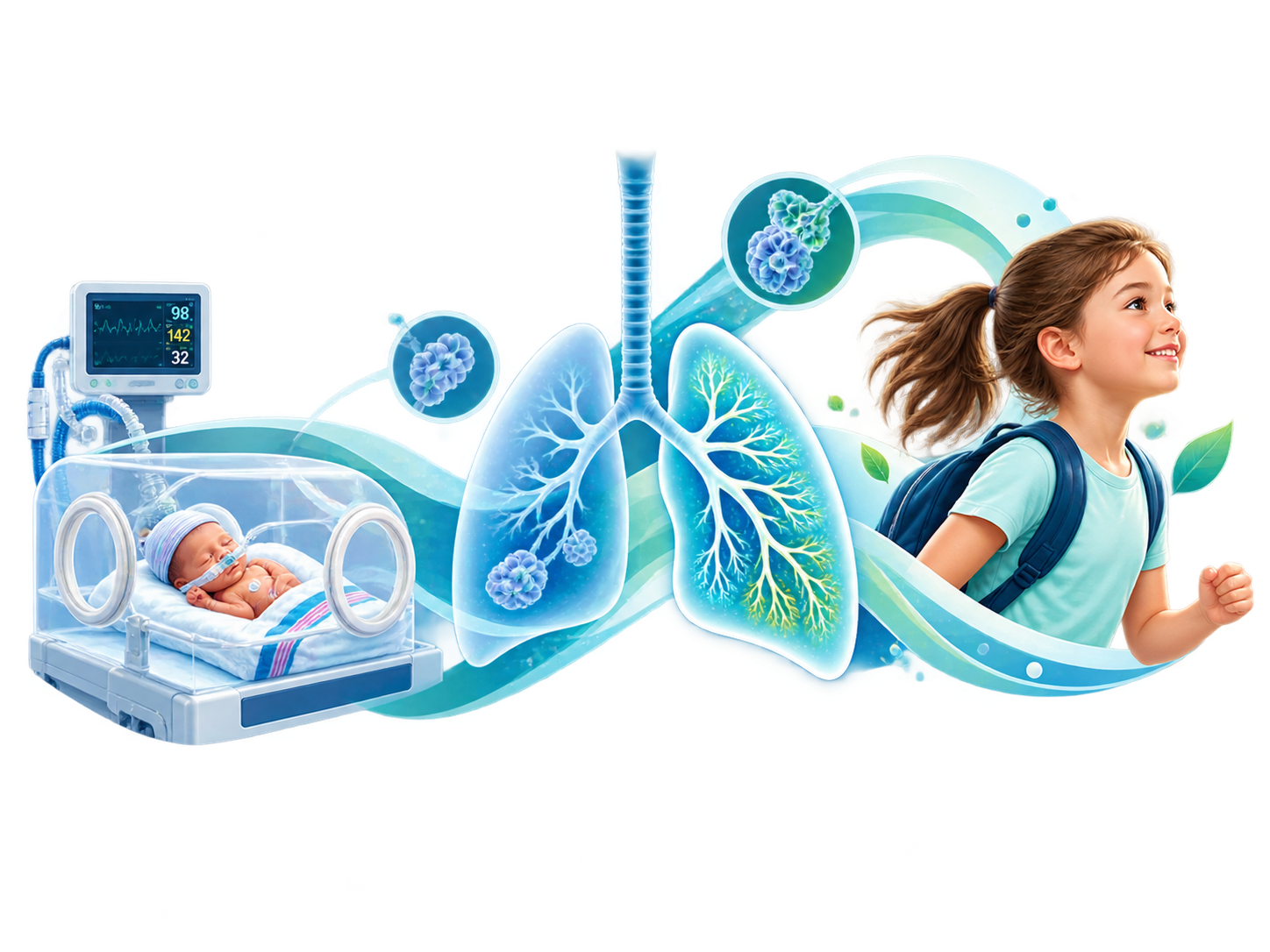
Respiratory health
The main 1-year respiratory outcome is parent-reported wheeze. Follow-up also records home oxygen, duration of oxygen supplementation, respiratory hospital admissions, respiratory medications and survival without wheeze.
AZTEC-FU follows children beyond 36 weeks’ postmenstrual age to understand respiratory health, neurodevelopment, growth, mortality and longer-term safety after neonatal azithromycin or placebo.

The primary AZTEC endpoint was assessed at 36 weeks’ postmenstrual age, but preterm birth and chronic lung disease can influence health well beyond neonatal discharge. The follow-up protocol therefore compares children originally allocated to azithromycin or placebo through 2 years’ corrected age.
The main 1-year respiratory outcome is parent-reported wheeze. Follow-up also records home oxygen, duration of oxygen supplementation, respiratory hospital admissions, respiratory medications and survival without wheeze.
At 2 years, the main neurodevelopmental outcome is survival without combined moderate/severe neurodevelopmental disability, supported by PARCA-R and available clinical developmental data.
Weight, length/height and head circumference are assessed alongside mortality and safety surveillance, including pyloric stenosis after early macrolide exposure.
The protocol combines parent-reported information with routinely collected clinical data so that respiratory, developmental and growth outcomes can be assessed as completely as possible.
Parents or guardians are contacted at 1 and 2 years’ corrected age. Questionnaires capture respiratory symptoms, admissions, antibiotic and respiratory drug use, growth and developmental information; the 2-year assessment includes PARCA-R.
Information can also be obtained, where consent permits, from hospital records, general practitioners, the National Neonatal Research Database and national health datasets.
The follow-up protocol describes children recruited from 28 tertiary neonatal units and approximately 77 step-down units across the UK.
Respiratory and stool samples collected during AZTEC support analyses of cytokines, proteomics, microbiome profiles, Ureaplasma colonisation and antimicrobial resistance.
In the main AZTEC trial, infants born before 30 weeks’ gestation were treated within 72 hours of birth with intravenous azithromycin for 10 days – 20 mg/kg for 3 days followed by 10 mg/kg for 7 days – or matched placebo. AZTEC-FU was designed to determine whether any effects of that early intervention emerge, persist or raise safety concerns during the first 2 years of life.
The wider preterm lung-health programme spans the neonatal period, infancy after discharge and childhood. AZTEC addresses intervention around birth; BALLOON focuses on respiratory health after discharge; RHiNO studies later lung function and prematurity-associated lung disease.